
The Knowledge LedgerThe Knowledge LedgerFollow on WhatsApp

A curated stream of high-signal insights across Technology, Healthcare, Lifesciences, AI, Oncology, Business, Entrepreneurship, Leadership, Philosophy and beyond.

Thoughtful, cross-disciplinary content designed to expand how you think, not just what you know.

No noise. Only substance.

Filtered by #decision-makingClear filter
Sep 12, 2026ยทx.com

Growth Is a Search Problem

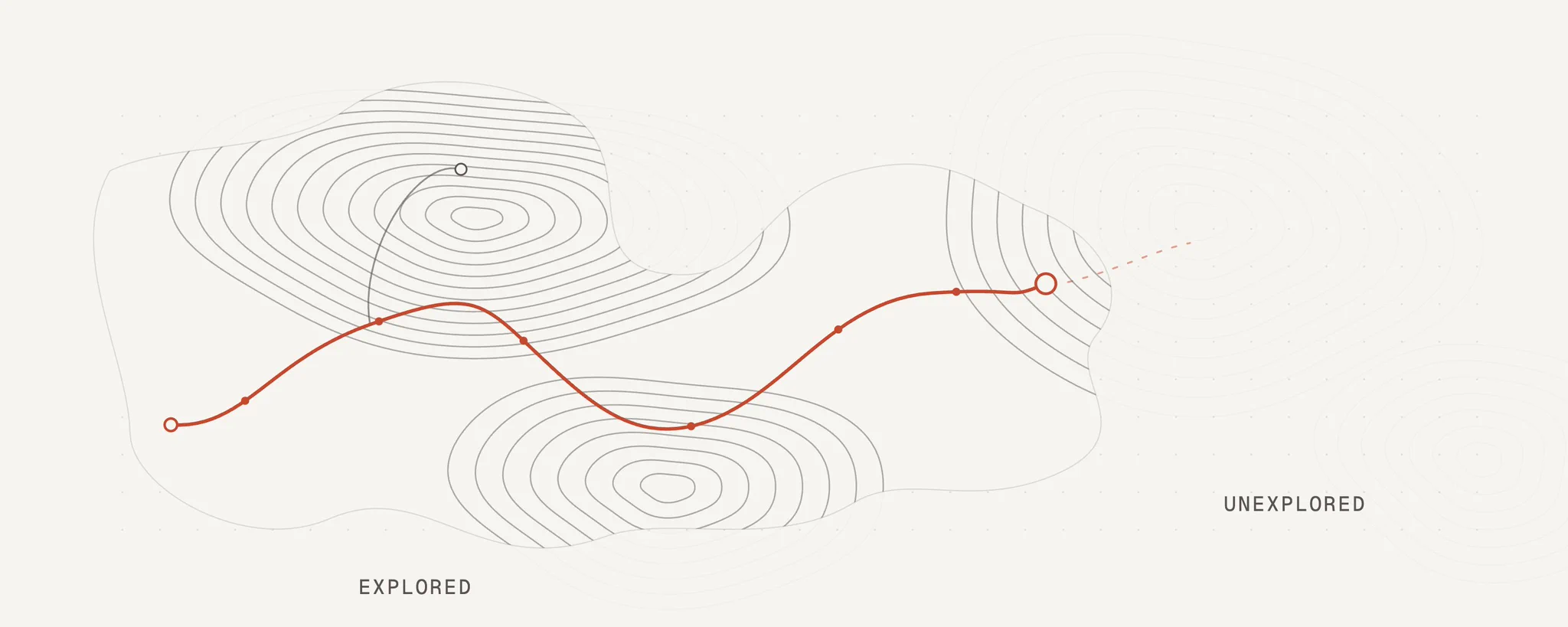
You start in fog, on a dark map, with an objective and no knowledge of which direction is uphill. The craft has always been a loop: hypothesize, move, observe, update. Hill climbing is one part of that loop. It can take you to a local peak, or up the wrong mountain if the proxy is wrong. One company optimized registered users. Another optimized people who actually came back.

AI changes the economics of the loop, not the geometry of the terrain. Agents can analyze, propose, ship, and interpret. You can now climb the wrong hill much faster. A rigid roadmap assumes the order of tests matches the size of the opportunities. Bandits waste less traffic on losers. A better strategy spends a small slice of budget mapping lever sensitivity first: poke the map, then climb where it makes a difference.

Sep 4, 2026ยทx.com

The GHOST in the machine

The bottleneck on consequential decisions is not analysis. It is not knowing how people will actually behave before you spend. Traditional research is slow, expensive, and often measures what people say rather than what they do. Synthetic populations invert that. Query a modeled public overnight, then spend on the human study only if the stakes require it.

Two camps are forming. One interviews real people, then enriches and re-queries them. The other rebuilds populations from census, traces, and panels, arguing that interviews import the same bias simulation is meant to escape. Buyers are more pragmatic than philosophical. Accuracy, traceability, and whether the output can survive procurement are the first gates.

Sep 1, 2026ยทx.com

Before 0 to 1 Comes -1 to 0

Most founder folklore starts at launch. The harder stage is earlier: figuring out what is worth the next decade. In isolation it feels like a squiggle. Talent makes it worse, because every capability is one more path that must be ruled out.

The old advice was to raise and throw things at the wall. That is a weaker bet now. Software has already eaten the easy fruit. AI makes it cheaper to build and easier for thin traction to become a local maximum. A low-conviction fundraise can consume years.

Jun 26, 2026ยทhbr.org

Great Leaders Question Philosophical Assumptions

Business leaders increasingly face decisions that are not just technical, financial, or operational โ€” they are deeply philosophical. Questions about what a company fundamentally is, what counts as valid knowledge or evidence, and what is ethically right are becoming central to strategy and leadership.

Yet most executives have never been trained to surface and examine these hidden assumptions. In a world where old certainties are breaking down, treating decisions as purely practical problems can lead to blind spots, misaligned priorities, and unintended consequences.