The Knowledge LedgerThe Knowledge LedgerFollow on WhatsApp

A curated stream of high-signal insights across Technology, Healthcare, Lifesciences, AI, Oncology, Business, Entrepreneurship, Leadership, Philosophy and beyond.

Thoughtful, cross-disciplinary content designed to expand how you think, not just what you know.

No noise. Only substance.

Filtered by #ai-infrastructureClear filter
Sep 16, 2026Β·x.com

Memory Is a View. History Is the Source.

Most memory systems decide on the write path. An event happens, a model extracts what seems important, and the rest is discarded. That keeps the store clean. It also asks the write path to know, at ingest, what will matter in three months. A detail that looks irrelevant in a support chat may explain an escalation later. Once the raw event is gone, better retrieval cannot recover it.

The better pattern is the old data-lakehouse move: preserve what happened, then build the useful representations later. Summaries, embeddings, graphs, and memories become replaceable views over an immutable history. The same conversation can yield one set of facts today and another next year. Better models can re-index old history. New agents can use it in ways nobody planned at capture time.


Aug 26, 2026Β·x.com

Dams, Not Moats

A common claim is that the flood of frontier intelligence will drown the application layer. There will be no moats left to build. That framing is incomplete.

Moats are useless against a flood. What matters are dams and waterways: systems that direct intelligence toward crops, reservoirs, and homes that would not otherwise receive it. Intelligence is a utility with unbounded demand. The world does not want raw models. It wants problems resolved and outcomes achieved.

Aug 24, 2026Β·arxiv.org

FreeToken: Making the Local Machine an Elastic Inference Platform

Most local serving systems treat a personal computer as a small GPU that must fit the model. FreeToken starts from a different premise. The machine is a unified, elastic inference platform whose CPU, GPU, and interconnect can be orchestrated continuously as workloads and available resources change.

The system is designed for Mixture-of-Experts models and for agentic workloads that repeatedly edit context and call tools. Its core techniques include bandwidth-adaptive execution (deciding in real time whether missing experts should be moved to the GPU or run on the CPU), semantic-aware state caching at natural boundaries, full-layer double buffering during prefill, and elastic reallocation of GPU memory between KV cache and experts.

Aug 24, 2026Β·arxiv.org

The Lifecycle of an LLM Judge

Most work treats an LLM judge as a static artifact. It is built once, scored against a fixed benchmark, and then assumed to remain valid. In production that assumption fails. Data drifts, catalogs change, and the distribution of failures shifts. A judge that is not maintained will quietly lose alignment with human judgment.

A better model is a lifecycle. The judge must be born, trained, deployed, and continuously monitored. Birth defines the evaluation criteria and creates human-labeled benchmarks that include not only pass/fail labels but rationales. Training refines the rubrics so the judge rejects bad outputs for the right reasons, not merely the right labels. Deployment puts the same judge into two roles at once: a quality gate and a critic inside a generate-revise loop. Monitoring samples live outputs, compares them with ongoing human judgment, and triggers re-tuning when agreement drifts.

Aug 13, 2026Β·silentroom.media

What a Token Actually Costs

A token is not a fixed unit of text. It is the output of a tokenizer. The same content can produce meaningfully different token counts depending on language, model version, and even quiet tokenizer updates. Non-English text routinely consumes more tokens. Output tokens are priced much higher than input tokens. Reasoning or β€œthinking” tokens are usually billed as output as well.

These mechanics create systematic opacity. Listed per-million-token prices are unreliable proxies for real cost. Cheaper models can end up more expensive overall because they consume more tokens to reach the same result. Subscription plans hide limits through silent model downgrades and non-comparable quotas. The practical consequence is that teams cannot budget accurately from published rate cards alone.

Aug 8, 2026Β·biorxiv.org

StainX: Making Stain Normalization Scale

Color variation across histopathology slides remains one of the most stubborn sources of noise in computational pathology. Different scanners, staining protocols, and laboratories produce images that look systematically different even when the underlying tissue is similar. This batch effect degrades the performance of AI models, especially foundation models trained across multiple institutions.

Classical stain normalization methods (Histogram Matching, Macenko, Reinhard) are training-free, interpretable, and effective. The problem is speed. Existing implementations process images sequentially or fail to fully exploit modern GPUs, making them impractical for the tens of thousands of tiles that make up large whole-slide image cohorts.

Jul 24, 2026Β·x.com

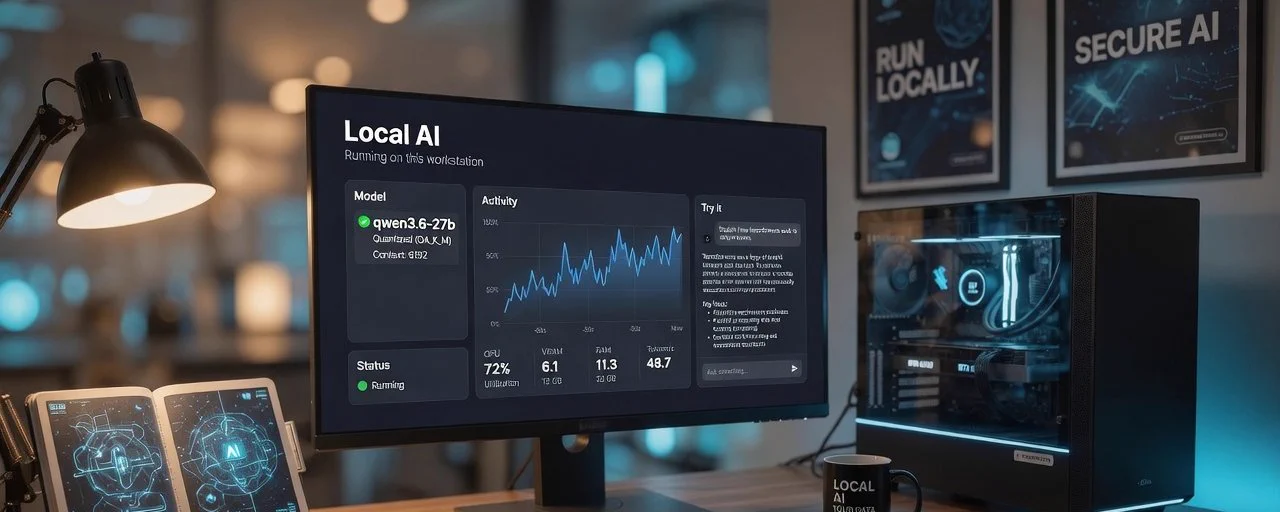
The Minimum Viable Baseline for Local LLMs

Running large language models locally requires compression. The practical question is how far you can go before quality becomes unusable.

Across benchmarks and deployment experience, a clear baseline has emerged: 4-bit weight quantization combined with 8-bit KV cache. This combination preserves roughly 92–99% of full-precision (BF16) quality and is the current minimum viable floor for most practical applications.

Jun 8, 2026Β·x.com

Heat Is the New AI Bottleneck

AI data centers are hitting hard physical limits β€” not just from chips or power supply, but from heat.

Modern AI GPU racks now draw 120 kW+, far beyond what traditional air cooling was designed to handle. Air can only move so much heat per cubic meter. Once racks cross ~50 kW, physics starts winning: chips overheat, throttle, or fail β€” not because the hardware broke, but because the cooling medium hit its ceiling.