
Agentic AI That Autonomously Discovers Cancer Biology
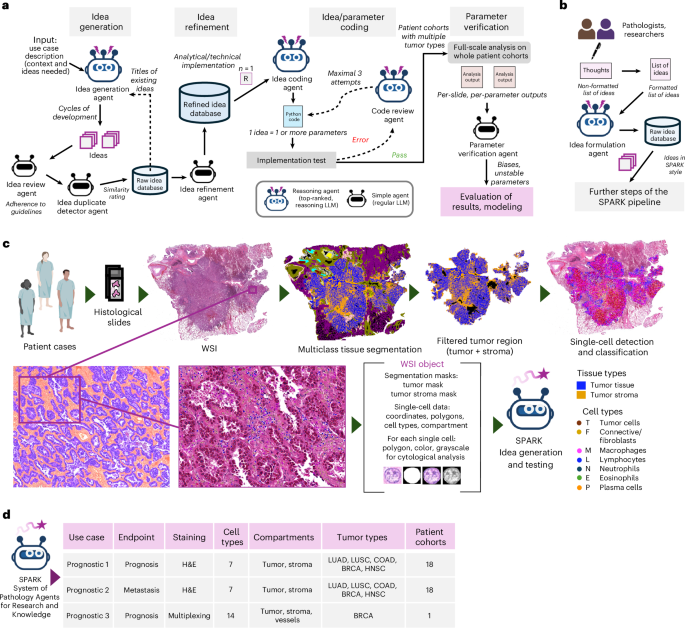
A new agentic framework called SPARK uses language as a universal interface to autonomously generate biologically meaningful hypotheses and convert them into analytical tools directly from routine H&E pathology slides.
No hand-crafted features or task-specific retraining are required. The multi-agent system handles the full pipeline:
• Quality control
• Tissue segmentation into tumor and stroma compartments
• Single-cell detection across 7 to 14 cell types
• Idea generation, refinement, executable code creation, and rigorous verification
It reasons over spatial patterns, morphology, and cell interactions to produce hundreds of interpretable parameters.
Evaluation scale
Tested across more than *5,400 patients* in 18 cohorts spanning five major cancers:
lung adenocarcinoma, lung squamous cell carcinoma, colorectal cancer, breast cancer, and oropharyngeal squamous cell carcinoma.
An additional spatial biology breast cancer dataset with 625 samples provided deeper tumor microenvironment insights.
Key results
• Strong correlations with tumor grade, stage, and predictive biomarkers (PD-L1, MSI, HPV/p16, ER/PR)
• Predictive models reached AUROC up to 0.933 for MSI inference
• Prognostic parameters delivered independent value in survival analysis and improved multi-tier risk stratification
• Infers temporal tumor evolution from static images — over 70% of aggressive features emerge in late-stage progression
This marks a foundational shift from supervised feature engineering to scalable, hypothesis-free discovery in computational pathology.
Useful for AI builders, oncologists, pathologists, digital biomarker researchers, computational biologists, and life sciences leaders.
Full paper: https://www.nature.com/articles/s41591-026-04357-y